Nepal has shaped Jessica Thomas' life in ways she never could've predicted. Growing up, her dad often spoke about the country: the mountains, the poverty he'd witnessed, the resilience of the people and the way the experience had changed how he saw the world.
At 19, Jess travelled to Nepal herself, trekking to Everest Base Camp and the Annapurna Circuit. One moment in the Himalayas, when she briefly lost the trail among snow and glacial moraine, stayed with her. She wasn't in serious danger, but standing there among the mountains made her feel small in the best possible way. It sparked a lifelong interest in travel, culture and community development, eventually leading her to complete a Master of International and Community Development and build a career that brings travel and positive social impact together.
Returning to Nepal: A Full-Circle Moment
Years later, returning to Nepal in April 2026 with her dad felt like a full-circle moment. This time, Jess wasn't only travelling through the Everest region, she was also supporting a World Expeditions Foundation project helping restore digital education in Thame, a remote mountain village in Nepal's Solukhumbu region.
Thame is recovering from a devastating Glacial Lake Outburst Flood that destroyed homes, infrastructure and critical community services, including the local school and its computer lab. With students relocated to temporary learning facilities, access to digital learning has been severely disrupted. The Rebuilding Digital Education in Thame project, led by Himalayan Trust Nepal, will help equip the newly relocated Thame Basic School with a computer lab, smart boards, printers and essential classroom infrastructure, giving students and teachers access to modern, technology-enabled education as the community rebuilds.
Arriving in Thame
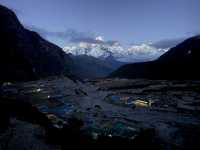
When Jess arrived in Thame, her first impression was one of awe and shock. Just moments before, she'd been watching huge Himalayan eagles circling overhead and taking in the scale of the valley. Then the evidence of the flood came into view. Massive boulders and muddy debris had been scattered across the valley floor, and the force of the water was visible in the landscape. But what stayed with her wasn't only the damage. It was the sound and movement of recovery. Everywhere she looked, people were rebuilding. There were tents from different organisations, construction materials stacked around the village and the constant sound of hammers and tools at work. It didn't feel like a place defined by disaster. It felt like a community focused on moving forward.
Why the Computer Lab Matters
For Jess, the computer lab matters because it restores an opportunity the community had already worked hard to create. The original lab had only recently been established before the flood destroyed it. Students had begun gaining access to digital tools and learning opportunities that many of us take for granted, and almost overnight that infrastructure was lost. In a remote mountain community like Thame, access to technology can help bridge the gap between geography and opportunity. It gives young people the chance to build digital literacy, access online learning, develop future skills and connect with the wider world while still remaining deeply connected to their own culture, family and community.
A Legacy of Long-Term Partnership
During her time in Nepal, Jess also spent time with Mingma and the Himalayan Trust Nepal team in Kathmandu, in the building that was once Sir Edmund Hillary's house. That visit gave her a deeper appreciation of the Trust's long-standing role in the Solu Khumbu region. This isn't an organisation arriving after a disaster and then leaving. Himalayan Trust Nepal has worked alongside communities in the Everest region for decades, supporting education, healthcare, livelihoods, environmental initiatives and cultural preservation. The computer lab is one piece of a much bigger picture: locally led development, long-term relationships and practical support that responds to what communities actually need.
Travel That Gives Something Back
Jess also raised funds personally for the project, creating a fundraising page through the World Expeditions Foundation before joining the Renjo La in Comfort trek. For her, it was a way to invite friends, family and fellow travellers into the story. "So many of us have been touched by Nepal in some way," she said. "This felt like a chance to move beyond simply being visitors and instead contribute to a community that has given so much to so many people." That's what she sees as the heart of regenerative tourism: rebalancing the relationship between travellers and the places they visit. Travel gives us perspective, connection, inspiration and joy. Supporting projects like this is one way to give something back.
The Impact
Through the
Rebuilding Digital Education in Thame project, 30 students will gain regular access to computers and digital learning tools, 10 teachers will be trained in ICT integration and interactive teaching methods, and 25 to 30 community members will have expanded access to basic computer training. The project will help restore learning opportunities after climate-related disruption and strengthen a more resilient education system for the future. For supporters and travellers, it's a reminder that travel can become more than a personal experience. It can become a bridge between people, places and practical impact.
A Community Already Moving Forward
As Jess reflected after visiting Thame, the community wasn't waiting for someone else to save them. They were already rebuilding, already planning and already moving forward. Support from Himalayan Trust Nepal, the World Expeditions Foundation and travellers around the world helps accelerate that recovery, but the resilience comes from the people of Thame themselves. And maybe that's the most important part of the story: hope isn't found in the absence of hardship. It's found in the determination of people to keep moving forward together.