More Inspiration

Lachlan Gardiner is a photographer who travels for a living. He went into the Great Patagonian Traverse with high expectations. What he didn't expect was how consistently the trip would surprise him - not by falling short, but by delivering moments he simply hadn't imagined.

If Patagonia is on your list and you're working out the how, here's what most people don't know until they've actually been.

The Itinerary Goes Places Most Patagonia Trips Don't

The Great Patagonian Traverse starts in Coyhaique in northern Chilean Patagonia and travels south over 15 days to Puerto Natales - largely on foot and by boat. It's not a loop. It moves through the region in a way that builds, each section revealing something the last didn't prepare you for.

The first three nights are spent at Terra Luna Lodge on Lago General Carrera, where the Northern Patagonian Icefield fills the horizon. From here the group jets up the Leones River by boat to reach the Leones Glacier - a wall of blue ice calving into an aquamarine lake that Lachlan described as one of the unexpected highlights of the entire trip.

From the lodge the route heads south along the Carretera Austral to Villa O'Higgins, a frontier town where the road simply ends. There is no way south by land. Instead, the group boards a boat across Lago O'Higgins - one of the deepest lakes in the Americas - before overnighting at a remote family estancia accessible only by water. The next morning, horses carry the luggage while the group walks through ancient beech forest and crosses two international borders on foot into Argentina.

"We felt like we were somewhere most people would never go. And most people wouldn't."

Terra Luna Lodge, Great Patagonian Traverse |  Lachlan Gardiner


The Comfort Level Will Surprise You

The itinerary crosses remote terrain, involves horse-backed luggage transfers and includes nights under canvas in Torres del Paine. None of that means you're roughing it.

Terra Luna Lodge sets the tone early - lake views, mountain backdrop, a spa and food that stays in the memory. In Torres del Paine the group stays in elevated platform tents at well-run refugios, with hot meals, local wine and craft beer at the end of each day on the trail. Main luggage is transferred ahead throughout. Your daypack carries your lunch and your layers.

The one genuine exception is the estancia at Candelario Mancilla, a working farm near the Chilean-Argentinian border where a local family has lived for generations. Basic facilities, no hot water - and according to Lachlan, the best meal of the entire trip.

"Slow-cooked beef and potatoes. It was just amazing. Really saying something when you've tasted Argentinian beef."

Homestay dinner on Great Patagonian Traverse |  Lachlan Gardiner


Two Days Under Fitzroy Is Not Enough

After crossing into Argentina the group reaches El Chalten, a small trekking town at the base of the Fitzroy Massif. Two full days of hiking are based here, with options to push as far or as easy as you like.

On the first morning Lachlan was up before the group, at a viewpoint above town watching the sunrise hit the mountain. The Fitzroy Massif at first light, he said, is more or less the perspective of the Patagonia clothing brand logo. He had three cameras running. He hadn't started trekking yet.

The biggest day from El Chalten covered close to 30 kilometres and nearly 40,000 steps - through orange-tipped beech forest, past turquoise glacier lakes and up to a high viewpoint with two hidden lakes that aren't visible from below. Some in the group took a shorter loop and still came back with outstanding views. The flexibility is built in.


Torres del Paine Is the Finale It Should Be

The last section of the traverse is the W-Trek through Torres del Paine National Park - four to five days of trekking that takes in Lago Grey and the Grey Glacier, the French Valley, and the ascent to the base of the iconic granite towers of Paine.

The group is in the park in peak season, and the main viewpoints do attract crowds. The local guides know this. An early start on the final morning meant arriving at the towers with only a handful of other people. Walking back down they passed hundreds heading up.

"We were very glad our local guides knew to get us up early that morning. It was totally worth it."

The W-Trek section uses permanent refugio camps with hot meals included. No tent setup, no carrying sleeping bags. Just a daypack and the trail ahead.

Hike to Torres Del Paine, Patagonia |  Lachlan Gardiner
 

What the Trip Actually Requires

The Great Patagonian Traverse is graded Moderate. The longest days involve up to eight hours of walking, but the pace is steady and the long Southern Hemisphere summer days mean there's no need to rush. No altitude acclimatisation is required - the route rarely goes above 1,000 metres.

Best time to travel is December through February. Fly into Balmaceda (BBA) and out of Punta Arenas (PUQ). Groups are small, guided by an expert bilingual leader throughout, with local specialist guides joining for key sections.

View Great Patagonian Traverse trip details and available dates.


To begin, a heartfelt thank you to everyone who travelled with us during our 50th year in 2025. Whether it was your first adventure or one of many, your support meant the world to our teams around the globe.

A special mention to those who joined us for our celebration in Sydney as well as at our 50th anniversary celebrations at Thyangboche, in Nepal. You helped us create one of the most memorable events in our company’s history. We’ve received so many kind messages and photos from that experience, and we look forward to sharing more of those stories throughout the year.

As we turn the page, 2026 brings a sense of quiet momentum. Not fanfare - just a commitment on offering the best adventure travel trips on earth. Focus on thoughtful travel, meaningful itineraries, and staying true to what we’ve always believed in: that small group adventure, done well, has lasting value.

 
World Expeditions 50th Anniversary Celebration in Thyangboche, Nepal |  Lachlan Gardiner Banquet at World Expeditions 50th Anniversary Celebration in Thyangboche, Nepal |  Lachlan Gardiner World Expeditions 50th Anniversary Celebration in Thyangboche, Nepal |  Lachlan Gardiner
 

What's Trending For 2026

Western Africa. Trekking in Kyrgyzstan. Madagascar. New trails in Japan. If you want to know our where people are travelling to, and how, check out our Top Destinations for 2026 article.


We've also noticed a shift in how people want to travel. Many are moving away from fast-paced, surface-level trips and towards slower journeys with more room to connect with nature, with local cultures, and most importantly, with themselves. 

Our Regenerative 2030 program continues to grow, with 34 projects already funded and more travellers choosing to support small, locally led projects through micro-donations and travel choices that align with their values.

Beyond our adventures, our Huma Charity Challenge division helped Australian charities raise over $2m in 2025 - we're looking to beat that in 2026!

We’re also seeing strong and growing interest in Indigenous-led travel, particularly in Australia. These experiences take time to build, and we’ll continue to work with care and respect as we grow in this space.

Active travel formats are broadening, too. Walking remains strong, but interest in cycling, active water-based journeys through our On Water Expeditions brand and slower paced adventures are also increasing. That will be reflected in some of the exciting new trips we will be introducing this year - stay tuned!


What I’m Excited About

One of the things I’m most looking forward to this year is a special Bush Tucker experience on the Larapinta with Rayleen Brown - a respected advocate and educator whose work connects people with Country through food. It’s a very special project and we’ll be sharing more details soon.

We'll continue to roll out even more Webinars, with some special guests to be announced soon. Our webinars provide a wonderful opportunity to hear directly from our guides, leaders and local experts. Check out some of the past ones to help you start planning for your next adventure.

You can also expect to see new culinary adventures and special guest-led trips across our program. 

Personally, I'm still reminiscing about my recent trek in Bhutan, a destination you'll hear alot more about this year, but those thoughts are slowly being replaced by my anticipation of returning to cycle China. I plan to revisit some of the routes that helped shape my early experience in this industry. We were the first company to offer cycling trips in China in 1978.

Druk Path Trek, Bhutan |  Lachlan Gardiner
 

New Journeys Launched This Year

We’ve launched several exciting new adventure ideas that reflect the way our travellers want to explore, with more time, deeper connection, and local insight.

Horse Treks in Remote Landscapes

Horses above our Yurt camp in the Tian Shan |  Lachlan Gardiner


We’ve introduced Horse Trek trips in places where horses are still central to daily life - including Mustang, Dolpo, Mongolia and Patagonia. These trips are designed to slow things down and connect you to the people that honor horses in everyday life, while offering access to breathtaking regions that are well away from the footpaths or roads.They’ve been carefully developed in collaboration with local partners and with a strong focus on animal welfare.

Queensland’s NEW World-Class Walking Experiences


We’re proud to be the official partner for two new significant guided walks:

  • The Ngaro Track on Whitsunday Island, created with the Ngaro people
  • The Thorsborne Trail on Hinchinbrook Island, one of Australia’s most remote and spectacular island hikes

Our staff who surveyed the walks last year cannot stop talking about these exciting new Australian hiking experiences. Get in early to be one of the first to experience them.

Sri Lanka - Taste & Spirit

Novice monks at Polonnaruwa |  Richard I'Anson


This new journey, led by food expert Jeremy Claasz, offers a warm, locally guided introduction to Sri Lanka’s food culture, sacred places and countryside. One of several new culinary-style experiences to watch for this year.


Looking Ahead

We’ll keep doing what we've been passionate about for 50 years - crafting small group adventures that are well operated, community minded, and grounded in real experience.

We’re also continuing to work steadily towards B Corp certification, which we hope to finalise later this year. It’s not a badge for us, but a useful framework to help ensure we’re staying accountable to the values we’ve always held.

Thank you for being part of this journey.

– Sue

Sue Badyari has led World Expeditions Travel Group since 1999. In 2025, she was recognised by Travel Weekly as Executive of the Year and Woman of the Year - recognition she credits to the people around her. She continues to work quietly behind the scenes to support the teams, partners and communities that make these adventures possible.


A Celebration Across Continents 

Fifty years ago, we set out on our first commercial trek into the Himalaya. Back then, trekking in Nepal was virtually unheard of for independent travellers, but we believed in the power of remote, responsible adventure. In September, we honoured that bold beginning with celebrations held on opposite sides of the world, one in Sydney, the other in Nepal.
 

Our Sydney celebration brought together long-standing staff, industry friends, media and past travellers, people who have walked alongside us in one way or another over the years. 

World Expeditions 50th Anniversary Party, Sydney Office

In Nepal, more than 70 trekkers set off on various trails across the Himalaya, eventually converging at the spiritual heart of the Khumbu, Thyangboche. Among them was a special group retracing our original 1975 route, joined by our CEO, Sue Badyari. Together, they marked an extraordinary milestone with what may well have been the highest birthday celebration on the planet – complete with cake, candles, and a live simulcast back to Sydney.

World Expeditions 50th Anniversary Celebration in Thyangboche, Nepal |  Lachlan Gardiner

As the sun dipped behind Everest’s flanks, laughter echoed from the mountainside and stories flowed freely. In both Thyangboche and Sydney, the energy was unmistakable, a shared pride in how far we’ve come, and a deep connection to the journey that began five decades ago.

World Expeditions 50th Anniversary Celebration in Thyangboche, Nepal |  Lachlan Gardiner


Honouring Our Purpose 


A standout moment came when CEO Sue Badyari joined the Sydney celebration live from the Everest region. “We’ve always believed in protecting the places we visit, supporting local communities, and making these journeys available to people who seek meaning, not luxury,” she said. “This isn’t a brand built on trends. It’s built on truth.” That sentiment echoed throughout the night. From the beginning, our focus has been on genuine travel experiences that connect people to place and leave a positive impact. 

World Expeditions 50th Anniversary Celebration in Thyangboche, Nepal |  Lachlan Gardiner

In Sydney, UTracks GM and long-time team member Kate Baker summed it up best: “Sustainability isn’t something we adopted – it’s something we were founded on. That’s why travellers return. That’s why so many of us have stayed.” 

Kate Baker and Brad Atwal at the World Expeditions 50th Anniversary Party, Sydney Office

We were proud to hear those words echoed by many others in the room, including brand ambassador and travel photographer Richard I’Anson, who reflected on decades of shared adventures. 

Richard I'Anson at the World Expeditions 50th Anniversary Party, Sydney Office


50 Years Forward 


This 50th year has not just been a celebration, it’s been a turning point. We are actively working toward B-Corp certification, have launched a carbon measurement framework, and recently hosted a Sustainability Symposium focused on regenerative travel practices. We’re not looking to grow for growth’s sake, we’re evolving in a way that stays true to who we are. 

World Expeditions 50th Anniversary Celebration in Thyangboche, Nepal |  Lachlan Gardiner


Thank You for Walking With Us 


Whether you’ve joined us on one trek or twenty, supported our guides and crew, worked in our offices, or simply followed our story - thank you. This celebration was for you as much as it was for us. And while we’re proud of what we’ve achieved over the past 50 years, we’re even more excited about where the next trail leads.

View of Mount Everest, during the 50th anniversary treks |  Lachlan Gardiner


Regenerative 2030 is the World Expeditions Travel Group’s long term commitment to ensuring travel creates positive and lasting change. It is guided by a simple idea. Travel can be a force for regeneration. We donate five dollars for every booking to the World Expeditions Foundation to support community led initiatives that restore ecosystems, strengthen communities and improve access to education.

One of the fully funded projects under this initiative has now reached completion. The Menstrual Packs for Equal Rights Project in Zambia has achieved its fundraising goal of three thousand six hundred dollars. This support has provided one hundred and fifty reusable menstrual packs for school girls in rural communities, delivered in partnership with the Luangwa Conservation and Community Fund. The project is known locally as Ufulu, which means freedom. This name reflects the purpose of the program. To give girls the confidence and freedom to attend school every day of the month without interruption.

Menstrual Pad Project |  Unknown
 

In many rural areas of Zambia, a lack of proper menstrual hygiene products results in girls missing up to one week of school each month. The consequences are long term. Reduced attendance leads to reduced learning outcomes and fewer opportunities. Early marriage is more common and confidence levels often drop. For low income families, boys are still more likely to be sent to school than girls. These barriers are compounded by stigma, limited education about menstrual health and the financial strain of purchasing safe sanitary products.

The Ufulu project addresses these challenges by providing high quality, washable and reusable menstrual pads made from breathable cotton and bamboo materials. They are sewn by local women employed through the initiative, creating fair income and valuable skills within the community. Each kit can be used for up to two years. Each one also reduces waste by replacing single use products with a sustainable alternative.

The project goes beyond the distribution of pads. It delivers education sessions that increase knowledge about menstrual health and hygiene. Girls learn how to care for their pads, how to understand their cycle and how to manage menstruation with confidence. This helps reduce stigma, improves comfort and supports dignity. Teachers and community members are also engaged to build a supportive environment within the school.

The impact is significant. Each menstrual pack saves approximately five school days every month that would otherwise be lost. Improved attendance means greater continuity in learning and improved academic outcomes. Girls report feeling more confident, more comfortable and better able to participate fully in classroom activities. The project is contributing to a shift in attitudes around gender equality and menstrual health in rural Zambia.

This initiative supports several United Nations Sustainable Development Goals. These include good health and wellbeing, gender equality, reduced inequalities, responsible consumption and production and quality education. By meeting these goals in a practical and community led way, the project reflects the core purpose of Regenerative 2030.

For fourteen years, Project Luangwa and its partner organisations have worked to improve education and gender equality across the region. Through this long standing partnership, communities have seen steady improvements in girls attendance rates, confidence levels and the breaking down of harmful stereotypes. The Ufulu menstrual pack project builds on this foundation by addressing one of the most persistent barriers to girls education.

Regenerative 2030 is about choosing regeneration over impact neutrality. It is about supporting local leadership and investing in the wellbeing of future generations. The successful delivery of this project in Zambia shows what is possible when travellers, community partners and local leaders work together. Every booking contributes to this work. Every project strengthens the resilience of people and places. Together, we are helping create a more equitable and sustainable future for girls in rural Zambia.


By Sherry Ott

I knew this trek would be different the moment I saw our group standing in a loose circle in Kathmandu, nervously smiling at one another. Eight women. Different ages, different countries, different life stories. Some were married and traveling solo for the first time. Some were single. Some were mothers. Some were devoted cat moms. But every single one of us had something in common: we wanted to hike in Nepal.

For many of them, this trip represented more than a vacation. It represented a chance to step outside their routines, to trust themselves, and to say yes to an adventure on their own.

When World Expeditions invited me to host their 50th Anniversary Women’s Trek in Nepal, I jumped at the chance. Not just because Nepal has long held a special place in my heart and I wanted to go back, but because I knew World Expeditions wasn’t simply creating another trekking itinerary. They were creating something meaningful, unique, and celebratory for women. 

As the trek unfolded, I realized World Expeditions had created a women’s trek that reflected a deeper, decades-long commitment to empowering women—not just as travelers, but as leaders, guides, and community partners. That commitment became visible everywhere I looked.
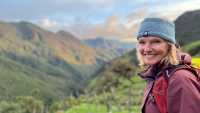
Sue Badyari, CEO

Female Leadership: A Vision Decades in the Making

In an adventure travel company, leadership shapes everything. It shapes company culture, hiring practices, the traveler experience, and even how communities are treated. And World Expeditions has something rare at its helm: a female CEO who has grown with the company from the ground up.

Sue Badyari joined World Expeditions in 1986 as a receptionist. Over four decades, she rose through the ranks to become CEO in 1999—a role she continues to hold today. Her leadership and contributions to the industry were recognized with the 2024 with a Lifetime Achievement Award, the 2025 Executive leader of the Year award, and Woman of the Year at Australias’s Women in Travel Awards by Travel Weekly. 

I think Sue’s journey mirrors the very spirit of adventure travel itself—starting somewhere small and unknown and slowly, steadily climbing higher! Under her leadership, World Expeditions has remained deeply committed to sustainable tourism, community partnerships, and expanding opportunities for women. Today, women make up 55% of World Expeditions’ travellers -a number that continues to grow as more women seek transformative outdoor experiences.

But what struck me most wasn’t just Sue’s title. It was the ripple effect of her leadership throughout the entire organization.
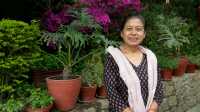
Uma Khakurel, Managing Director of World Expeditions Nepal |  Caroline Mongrain

Female Leadership on the Ground in Nepal

I was surprised to find that leadership wasn’t just at the executive level—it was deeply embedded within World Expeditions’ Nepal operations too!

Uma Khakurel, the Managing Director in Nepal, has been with World Expeditions for 32 years. In a country—and an industry—where leadership roles are traditionally dominated by men, Uma’s position is rare. Her steady presence ensures that operations run smoothly in a caring, thoughtful way, while also creating space for more women to enter the field.

Uma’s longevity reflects both competence and the company’s commitment to investing in female leadership locally. Her perspective has helped World Expeditions build something sustainable and inclusive, season after season.

And then there were the guides.
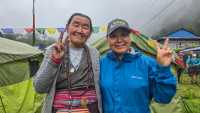
Meet "Mama G", our local guide, with "Gaga", the landowner hosting our exclusive campsite |  Sherry Ott

Meet Mama G: Carrying Trekking in Her Blood

Our lead guide, Dawa Yangin Sherpa, affectionately known as “Mama G”, carried both strength and warmth. Trekking wasn’t just her job; it was part of her heritage. Her grandfather had been the first trekking guide in the Khumbu region, and she grew up watching trekkers pass through her village while her father worked as a porter.

As I was growing up pretending to be Charlie’s Angels, Mama G and her friends would pretend to be tour guides, speaking fake English and leading imaginary trekkers along village trails. “We didn’t know English,” she told me with a laugh. “So we just spoke gibberish.”

But her path to becoming a guide required persistence—especially as a girl in a remote mountain village.

She walked three hours to school each day, often in the dark. In winter, she stayed with her aunt so she could continue her education. Out of five girls from her village who started school, she was the only one who continued beyond primary school.

There was a cultural belief that educated women would not find husbands. Women were expected to work in the fields and care for the household. But Mama G kept going. She earned a scholarship, completed secondary school, and eventually earned a bachelor’s degree in population education. Later, she even spent six months in the UK to improve her English.

“We were just happy to go to school,” she told me. “Education was everything.”

That education, and her determination, opened doors.

Breaking Barriers on the Trail

When Mama G began guiding for World Expeditions, she was the only female guide among 35 men.

“There were challenges,” she told me. “Females are expected to stay home and take care of the family.”

Even her husband and in-laws initially discouraged her from working. And her friends didn’t understand how she could leave home for weeks at a time.

Mama G told me that when she first became a guide, it was Uma who gave her the authority to lead. “At first, it felt strange telling the men what to do,” she admitted. “But Uma supported me.” Today, the crew calls Mama G Didi, or big sister, a term of respect that reflects how fully she has grown into her leadership role.

Today, she leads treks regularly and has helped provide opportunities for her two daughters, ages 18 and 14, both of whom are educated and speak English fluently. Her goal, she told me, was to give them a better life. And she most definitely has!

There was something deeply meaningful about being guided through the Himalayas by a woman who had fought so hard to stand there herself.
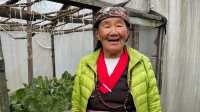
Ngima Doma Sherpa, lovingly called “Gaga,” meaning “grandmother” in Sherpa |  Caroline Mongrain

Empowering Women Beyond the Trail

World Expeditions’ commitment to women extends far beyond their guides. It reaches into the very communities where they operate.

At our first eco-camp stay, we were welcomed by Ngima Doma Sherpa, whom everyone lovingly called “Gaga,” meaning “grandmother” in Sherpa. She owns the land where the camp sits, and World Expeditions partnered with her to create a permanent campsite that provides her with a steady income and employment. She no longer has to make grueling trips to the Lukla market to sell her produce.

After losing her husband and son, Gaga now helps maintain the camp and prepare food for trekkers. Her partnership with World Expeditions provides both financial stability and independence.

I’ve always believed tourism should benefit local communities—not displace them. That’s exactly what World Expeditions is doing here, making travel more local and sustainable. 
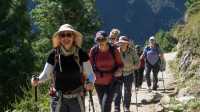
Women hikers sharing the trail in the Nepal Himalaya |  Sherry Ott

Why Women Want to Travel Together—Especially in Challenging Destinations

As our women’s group settled into the rhythm of trekking, I noticed something I’ve seen repeatedly on women-centric trips: the speed at which strangers become friends. Women are so inclusive, and I love that!

When I asked some of the women why they chose this trip, their answers were honest and deeply personal.

Jodi told me, “It’s liberating to travel on your own and only worry about yourself. You don’t have to take care of anyone else—you can just be present.”

Carol shared something that stuck with me. “Here, I don’t have to be someone’s wife or mother. No one knows me. I can just be me.”

Sue, who was visiting Asia for the first time, admitted she wasn’t sure she had the confidence to come to Nepal alone. And Amanda told me Nepal had been on her list forever. “There’s nothing like the Himalayas,” she said, gazing up at the peaks that surrounded our campsite.

Women create an environment where we feel comfortable asking questions, challenging ourselves, and supporting one another. Instead of competition, there is encouragement. Instead of comparison, there is connection. That’s just how women operate. 
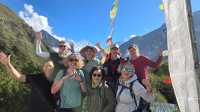
Smiles on the trail as women discover the power of travelling and trekking together |  Sherry Ott

The Transformative Power of Women Traveling Together

By the end of the trek, the group dynamic had transformed completely.

We had watched each other push through altitude and fatigue. We had laughed together over games at camp. We had marveled at the strength of the porters, watching them carry loads up steep trails with a quiet efficiency that made our own efforts feel small by comparison.

More importantly, we had watched each other grow.

Women gain confidence when they step into unfamiliar environments and realize they are capable. They discover independence. They begin to trust themselves in new ways.

And often, they carry that confidence home with them.

Why World Expeditions Is Leading the Future of Women’s Adventure Travel

What makes World Expeditions unique is that their commitment to empowering women exists at every level of the organization.

From Sue Badyari’s leadership as CEO, to Uma Khakurel’s operational leadership in Nepal, to female guides like Mama G, to women like Gaga who partner with them in local communities—women aren’t just participants in the story. They are creating the story.

This isn’t symbolic empowerment. It’s a long-term investment creating pathways where none existed before.

And I could see the results—in the women leading the treks, in the women supporting their families, and in the women hiking and standing at mountain viewpoints, realizing they are capable of more than they ever imagined.
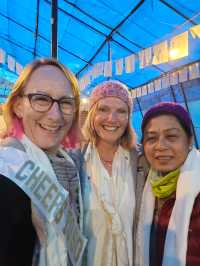
Women pushing boundaries: Sherry Ott, Sue Badyari and Uma Khakurel |  Sherry OttWhen Women Lead, Everyone Moves Forward

When World Expeditions invited me to host this trek, I said yes because I believed in what they were building. But walking alongside Mama G, hearing her story, and watching our group of women grow stronger each day helped me understand it on a deeper level. 

This wasn’t just about trekking in Nepal. It was about creating space for women to step outside the roles and routines that often define their lives and discover who they are beyond them. It was about local women like Mama G, who refused to accept limitations placed on her, and travelers who arrived unsure of themselves and left with a new sense of confidence. 

Thanks to women like Mama G—and the opportunities created by companies like World Expeditions—I know more women will continue to step into the unknown, discover strength they didn’t know they had, and realize they belonged there all along.

Sherry Ott Bio
Sherry isn’t just another travel blogger—she’s a trailblazer in new media, sharing her journey of global adventures and unconventional living on Ottsworld.com since 2006. With a passion for empowering women to break free from societal “shoulds” and step boldly out of their comfort zones, Sherry redefines what it means to explore the world.

From epic escapades in far-flung destinations to inspiring others to conquer their fears, Sherry’s mission is clear: to help you see the world—and yourself—in a whole new light. Let her stories spark your next adventure and transform the way you travel.


You do not just visit Upper Mustang with Margie. You are welcomed into it. 

On our small group journeys in Mustang, Margie’s long standing relationships open doors that regular travellers simply walk past. 

This season, those connections translated into practical support for local families and students, while you explored one of the Himalaya’s most culturally intact regions.

Why her recent Mustang trip mattered

In Upper Mustang, reliable light can be the difference between a child studying after dusk or not at all. Thanks to a partnership effort, Margie delivered solar lamps, supplied by Paddy Pallin, to households experiencing energy poverty. 

The handovers were simple moments with big impact - a lamp placed into a grandmother’s hands, a shy smile from a student who can now read at night, a family kitchen lit safely without kerosene. Three short videos capture these exchanges, but the real story is the ripple effect you help create when you travel with purpose on a Mustang tour.

  • Education: AUD 8000 to Lekshey Choeling Monastic School
  • Women’s health: AUD 2000 to Meson Women Health Camps
  • Scholarships: AUD 5100 for students from Upper Mustang in the Annapurna region

Margie Thomas delivering solar lamps, courtesy of Paddy Pallin, in Mustang


Cultural immersion on a Mustang tour

Upper Mustang sits in the rain shadow near the Nepal and Tibet frontier, a high desert of ochre ravines and whitewashed villages where Tibetan Buddhist traditions continue as they have for centuries. 

With Margie you explore Lo Manthang at 3830 m or 12,566 ft, meet Amchi healers, visit cave monasteries, and time your visit to coincide with the Yartung Horse Festival - ceremonial processions, songs, dancing and displays of horsemanship that few outsiders witness.

As Margie says, “Upper Mustang is just so different from anywhere else in the Himalaya... far more untouched, and far fewer tourists go there.”

Ride sure footed Tibetan ponies to Chosar

One highlight of a Mustang trip with Margie is reaching Chosar village by Tibetan pony. You pass cave monasteries and arrive where women wear ornate traditional dress sets unlike anywhere else in the region. No previous horse riding experience is necessary. Ponies are calm and sure footed and you can walk any section you prefer.

Yartung horserider |  Luigi Fieni


Why travel with us on Margie’s Mustang tours

  • Unmatched access: Margie’s relationships with local families, monastic communities and cultural custodians create meaningful encounters that anonymous travel cannot match.
  • Depth with care: You see living culture on its own terms - from Thubchen gompa’s restorers to the Royal family’s role at Yartung.
  • Comfortably supported: Vehicle links between valleys, day walks and optional pony rides, hearty meals on trek, and wilderness first aid trained staff.
  • Positive impact: Every Mustang tour helps fund education and health initiatives selected with local leaders.
     
Margie Thomas delivering solar lamps, courtesy of Paddy Pallin, in Mustang Margie Thomas delivering solar lamps, courtesy of Paddy Pallin, in Mustang Margie Thomas delivering solar lamps, courtesy of Paddy Pallin, in Mustang

Common concerns, answered

I have never ridden a horse. Riding is optional. The Tibetan ponies are small, calm and sure footed. You can walk any sections you prefer.

I am unsure about altitude. The sequence allows gradual acclimatisation. We use vehicles to manage daily gains and monitor you closely. Lo Manthang sits at 3830 m or 12,566 ft and our leaders are trained to support you.

I am not a hardcore trekker. This is an immersive cultural journey with day walks and cultural visits rather than a continuous point to point hike. It aligns to our Introductory grade guidance for active travellers who enjoy walking and exploration with support.

Next tours with Margie - always up to date

Want the latest Mustang tours and other destinations Margie leads in future seasons? Use this live search page. It automatically shows any upcoming departures as they are released.

See upcoming Mustang trips and other tours with Margie

Travel with purpose

If you are ready to see Mustang with a guide who is part of the community, not just passing through, join Margie on our next Mustang tour. You will experience a culture that has endured for centuries and help keep study lamps on, classrooms open and health services running for the people who host you.

Photographs courtesy of @marionwheelerphoto (www.marionwheeler.com)


As I plan in my mind how to write this story, I am at 3,800 metres altitude, trekking in the Tian Shan mountains in Kyrgyzstan in Central Asia. I also have Parkinson's Disease, an incurable progressive disease that primarily effects movement. I thank my companions on this trek for their patience. I am a little slow but not badly. My balance is not good and I have to do some sections on all fours. Our guide Vlad is great. When I want to do it my way he stands back but is always right behind me if I ask for help.

But let's start at the beginning.

Seven years ago I felt some strange unconnected things. I was walking with my hands out in front of me rather than by my side. I also had difficulty recognising faces 1, had hot flushes 2 and fatigue. I had reported the hot flushes to my GP but nothing was identified as the cause.

I was a bit annoyed. I felt I had not slowed down, everybody else had sped up. This may have tested a few friendships.  

Tony Forster in Kyrgyzstan |  Lachlan Gardiner
 

I felt that something was not right but was reluctant to go to my doctor with the concern that I was walking with my hands in front of me. I decided to leave it 'till it got better or worse. With that decision to “park” the problem I gave it no more thought. It did get worse but I didn't notice because I had “parked” it.

Until Christmas dinner. My sister said to me that I was not quite right. I instantly knew she was correct. I “un-parked” it. I saw the doctor as soon as possible and was referred to a neurologist. I did not know what to expect. If it was Motor Neuron Disease I had 4 years.3 Multiple Sclerosis shortens life by 7 years.4 Parkinson's is the best of them. Most people with Parkinson's disease have the same, or similar, life expectancy as those without the disease.5 Parkinson's is about quality of life not a quantity of life.

Parkinson's was a hard thing for me to accept as I had planned to spend my retirement years doing adventure sports like ski touring, snow camping, cycling and trekking.

By chance, I was due to lead a cycle trip, from Vienna to Rome in a few months and there was a planning meeting immediately after my neurologist appointment. With tears of joy6 I told my friends that I was not going to die and would still be able to lead the planned cycle trip.

I stopped at a pharmacist on the way home and filled the prescription, bought a coffee and took my first pill. I used to enjoy driving but had lost interest. Now I could see why. The colours and textures of the roadside vegetation were again so beautiful.

An early problem with an incurable condition is when and how to disclose it. I think we fear being judged as inferior and risk judging ourselves as inferior. There is stigma attached to poor health, particularly mental health. I made the decision to over disclose rather than under disclose. It's bad enough having an incurable disease without having to hide it or feel diminished by it.

Because I am quite open about my disease I know a few people who have Parkinson's. Compared to them, I have been lucky. My disease is progressing quite slowly. It may help that I exercise quite a lot including walking and cycling. Exercise is neuro-protective and cycling7 particularly so.

Friends and relatives of people with Parkinson's sometimes point to me and my active lifestyle and ask whether their friend would have benefited from copying my lifestyle. This is unfair, often the person had Parkinson's appear much to rapidly to change their lifestyle. It is victim blaming with its assumption that the victim did something wrong, that in some way it is their fault.

The symptoms of Parkinson's vary greatly from person to person and with time. Symptoms are categorised as motor (related to movement) or non-motor. The motor symptoms are much better known by the public but the non-motor symptoms may be more of a problem to sufferers.

Tremor is the best known symptom of Parkinson's. I have never had tremor. Probably, my biggest problem is REM sleep behavior disorder (RBD).This is not just sleep walking and sleep talking, it's sleep shouting and swearing, sleep leaping and falling. I have destroyed 2 tents in my sleep in the last year. This is a problem for activities in remote locations where a tent is not just for comfort; it is a matter of survival.

There is the amusing side too. I have woken trying to climb a brick wall at the head of my bed using the grout lines as finger and toe holds. Another time I dreamt that I was using a rope to climb a rock ledge. I woke hanging off the side of the bed using the sheet as a rope. I can be quite rational in a dream, aware that I am dreaming and able to decide whether to wake up or not.

So, I inch my way along a steep path leading to a high pass. I am clumsy with increased risk of a fall. But I am keeping up. I am still in the game, that's what matters. Life is good!


1    My research, not my doctors',.A literature search gives many references eg. Perception and memory for faces in Parkinson's disease https://www.sciencedirect.com/science/article/abs/pii/002839329190072G

2    My research, not my doctors', many references https://www.gondola-medical.com/news/parkinsons-symptoms-10- initial-and-early-symptoms/


  3    My research, not my doctors' https://www.ncbi.nlm.nih.gov/pmc/articles/PMC1123440/

  4    My research, not my doctors' https://www.medicalnewstoday.com/articles/310832

  5    My research, not my doctors' https://www.medicalnewstoday.com/articles/parkinsons-life-expectancy.

  6    https://davisphinneyfoundation.org/pseudobulbar-affect-parkinsons/ No doctor has suggested I have pseudobulbar affect (PBA) but it seems a good fit. PBA, sometimes referred to as “emotional incontinence,” causes short episodes of sudden, unpredictable, uncontrollable laughing, crying, or frustration and anger. (Crying is the most common.) These episodes are frequent, can occur at any time, and are often incongruent with the person’s feelings.

  7    My research, not my doctors' Parkinson’s disease patients benefit from bicycling - a systematic review and meta- analysis https://www.ncbi.nlm.nih.gov/pmc/articles/PMC8463550/

  8    My doctors have never mentioned the words REM sleep behavior disorder (RBD) to me but I think we have agreement on this. https://www.parkinson.org/understanding-parkinsons/non-movement-symptoms/sleep-disorders


Written by Tony Forster, who travelled with us on our Kyrgyzstan & Tian Shan Mountains trek in 2024.


Kyrgyzstan is a hidden gem nestled in Central Asia, with its capital, Bishkek, serving as the perfect launchpad for our adventure. Surrounded by the majestic Tian Shan Mountains, Bishkek is a blend of history and vibrant culture. As we head towards Son-Kul, a breathtaking lake situated at 3,000 meters, we pass through stunning landscapes marked by dramatic rock formations.
 
Upon reaching Son-Kul, we stayed in traditional yurts that were warm and inviting despite the chill of the high altitude. One highlight was learning the art of yurt-making, a skill deeply embedded in Kyrgyz culture. And a scenic highlight was wandering Fairy Tale Gorge and then having fresh fruit after exploring the nooks and crannies of paths travelled by very few.
 
Traditional Kyrgy musician on the shores of Son Kul |  SB

While at Son-Kul, we were entertained by a traditional musician playing a string instrument akin to a banjo, showcasing a unique style of singing that resonated with joy and authenticity. It was during these moments that I truly felt the warmth of Kyrgyz people—they share their lives and stories generously, expecting nothing in return. This is also shown at every meal time, where food is displayed down the middle of the table. It makes every occasion feel like a celebration.


So the start of our trek was marked by herds of horses grazing freely, and we often paused to take in the vibrant meadows and bubbling rivers. Our first night was spent in a yurt camp after a day filled with exploration. It was lush, and green, with every view overtaking us with awe.
 
Trekkers enjoy the beautiful alpine valleys of the Tian Shan |  SB

As we ascended towards Teleti Pass, the beauty of the landscape just grew more and more dramatic. The trek of course challenged us physically and mentally but everyone supported each other, and with every step, we were greeted by panoramic views of the surrounding peaks, a constant reminder of nature's grandeur.
 
View of campsite and Ala Kul Lake |  SB

Our adventure took us to Ala Kul Lake, a shimmering jewel at 3,200 meters, where our camp was amidst breathtaking scenery. After a day of exploration, we climbed to Ala Kul Pass, marvelling at the stunning ring of mountains that encircled us. Agin, the landscape completely changed, but was equally as impressive. The winding path down will stay in my mind forever.
 
Trekkers on the ridge of Ala Kul Pass |  SB
 

On our descent, we revelled in the lush Karakol Valley, encountering local villagers, their yurts, and the freedom of the wild horses that roamed the landscape again. We soaked in natural hot springs at the end of our trek, which was a perfect way to relax after the days of hiking.

As we made our way back to Bishkek, I reflected on the diverse experiences and the genuine kindness of the Kyrgyz people. Their harmonious coexistence of different cultures and faiths only added to the richness of the journey. From the stunning landscapes to the heartfelt connections, Kyrgyzstan has left an indelible mark on my travel memories. 

Peace. We could sure use more of it, but how can travellers foster the concept just be, well, travelling?

The International Institute for Peace through Tourism (IIPT) asked us, along with the travel juggernaut Flight Centre, to share our innovative approaches to integrating peace and sustainability into the tourism industry.<

Donna Lawrence, our Global Sustainability & Impact Manager, along with Michelle Degenhardt, Global Sustainability Officer at Flight Centre, shared with them some enlightening perspectives on how the tourism sector can champion global harmony and cultural respect.

Donna focused promoting cultural preservation and combating monoculturalism through reconciliation and acknowledgement of traditional owners. She argues that tourism thrives on diversity and that preserving traditional cultures is essential for a vibrant global society. 

The World Expeditions Reconciliation Action Plan with Australian Aboriginal and Torres Strait Islander peoples exemplifies this commitment, aiming to build respectful, lasting relationships and integrate cultural insights into their travel offerings.

 
Local family on the World Expeditions community project trip in Arnhem Land, NT |  Gesine Cheung
 
Drawing inspiration from Mark Twain’s belief that "Travel is fatal to prejudice, bigotry, and narrow-mindedness," Lawrence underscored the role of travel in challenging and expanding worldviews. We have been a charter member of the Travel for Peace campaign since its inauguration in 2016, advocating for travellers to embody the principles of peace and respect articulated by the IIPT.

A key component of our strategy is creating transformative travel experiences that foster empathy and connection. 
"We believe that transformative travel helps broaden perspectives and build peace," Lawrence noted. 
Our are designed to immerse travellers in less-travelled destinations, encouraging deeper cultural engagement and appreciation.
 
Engaging with villagers that rarely encounter trekkers |  Lachlan Gardiner
 

Flight Centre's Degenhardt emphasised a different but complementary aspect of peace-building through tourism, that fostering a culture of peace extends beyond merely avoiding conflict. For her, it encompasses promoting tolerance, understanding, and respect for human rights.

"Our mission is to open up the world for exploration, but this must be coupled with a commitment to responsible travel," she said. Flight Centre advocates for travellers to engage with local cultures, support local economies, and practice environmental stewardship.


Local woman working in a silk factory in Samarkand |  Alesha Bradford
-

>Both leaders agree that the tourism industry has a significant role to play in fostering peace by promoting cultural understanding and sustainable practices. Degenhardt and Lawrence’s insights reveal that travel, when conducted mindfully, can be a powerful tool for peace and cultural enrichment.

As we reflect on the theme of World Peace Day and World Tourism Day for 2024, the IIPT message, and the vision of a global peace industry is within reach. By embracing responsible travel practices and supporting initiatives that respect and preserve cultural diversity, the tourism sector can indeed become a catalyst for a more peaceful world.

How do you spread peace through your travels? Share your tips in the comments


In a world increasingly seeking unity and understanding, the tourism industry has the potential to be a powerful force for peace. As we observe World Peace Day and World Tourism Day, it's an opportune moment to explore how travel can contribute to building a culture of peace and mutual respect across the globe.


At its core, peace is not merely the absence of conflict; it involves fostering tolerance, respect for human rights, and cultural understanding. The tourism industry, with its unparalleled ability to connect people from diverse backgrounds, is uniquely positioned to promote these values. By encouraging responsible and mindful travel, the industry can play a pivotal role in cultivating global harmony.

The Power of Cultural Exchange
Travel provides an invaluable opportunity for cultural exchange. Immersing oneself in a new culture—by engaging with local communities, learning about their traditions, and participating in local customs—can significantly enhance mutual understanding and respect. When travellers approach new cultures with an open mind and heart, they not only enrich their own lives but also contribute positively to the communities they visit.
Cultural exchange fosters empathy and breaks down prejudices by allowing individuals to experience and appreciate diverse ways of life firsthand. This direct interaction challenges stereotypes and broadens perspectives, creating a more inclusive and harmonious global society.


Supporting Local Economies
Travel can also be a significant driver of economic development in local communities. By spending money on local businesses, travellers help boost local economies, which can lead to improved infrastructure and services. However, this support must be conducted responsibly to ensure that it benefits the community genuinely and sustainably.

Promoting sustainable tourism practices, such as staying in eco-friendly accommodations and supporting businesses that prioritize ethical practices, ensures that travel contributes positively to both the environment and the local economy. This responsible approach to tourism helps preserve the natural beauty and cultural heritage of destinations while providing economic opportunities for local populations.

Preserving Natural and Cultural Heritage
Sustainable tourism is critical in protecting natural landscapes and cultural sites from over exploitation. Tourists can play a role in conservation by following guidelines that minimize their impact on the environment and respecting cultural sites. When travellers are educated about the importance of preserving these assets, they are more likely to act responsibly and advocate for their protection.


Efforts to preserve cultural heritage include supporting initiatives that protect traditional practices and languages, ensuring that tourism enhances rather than diminishes local cultures. Respecting and valuing the traditions and customs of host communities helps maintain cultural diversity and promotes peace by acknowledging and celebrating different ways of life.
Local trackers preparing for a traditional Bushman dance around the campfire |  Ashley Hewson


Transformative Travel Experiences
Transformative travel goes beyond mere sightseeing. It involves engaging in experiences that lead to personal growth and a deeper understanding of the world. Such travel experiences often foster a sense of connection and empathy, contributing to a more peaceful outlook and behaviour.


Participating in activities that promote community development, environmental conservation, or cultural exchange can profoundly impact both travellers and host communities. These transformative experiences help build lasting connections and contribute to a more compassionate and interconnected world.


The Role of Tourism in Global Peace
As the world grapples with complex challenges, including conflict, inequality, and environmental degradation, the tourism industry has an opportunity to be a force for good. By promoting responsible travel practices, supporting local communities, and preserving cultural and natural heritage, tourism can contribute to global peace and harmony.


Incorporating principles of peace into travel not only enhances the travel experience but also supports broader global efforts towards a more just and understanding world. As travellers and industry professionals alike embrace these values, the vision of tourism as a catalyst for global peace becomes increasingly attainable.


This World Peace Day and World Tourism Day, let’s commit to making travel a vehicle for positive change. By prioritizing respect, sustainability, and cultural appreciation, we can help build a more peaceful and interconnected world through our journeys.

Mr Su is a part of World Expeditions history. He was there when we were the first company to operate cycling tours in China almost 40 years ago, a time when he couldn't have even thought to own a car. Now, with driving one of his favourite forms of travel, and feeling more optimistic about tourism in China post-Covid, he recounts some fun and key highlights during his time at World Expeditions.


Hello ‘Mr Su’. Please tell us a little bit about yourself. 

Hello! I live in Guangzhou, China where I run a travel company which operates both in-bound tourism and out-bound as well. I have a family of 3, my wife (who works in our company) and my daughter. My daughter lives in California with my 7 year old grandson, so we travel to the USA often to visit the.

I feel very fortunate that I chose a career that I could devote myself to it for my whole life, because I always love travel. I’d love to see the outside world since I was a child. And I love to bring people to see our own world and our people the outside. Besides travel, I love hiking, biking, fishing and driving. I love cars. For me, a car means freedom of travel.

I have worked for World Expeditions China tour program since 1986, when I was 25 years old. Now I am 63, and have helped the company with over 600 China adventure tours during my career. 

When did you first begin in the tourism industry in China? 

My first job after my graduation from college was arranged by the government. Those days in the 70s and 80s the government paid for our education and assigned us to work for them. 

It was not like now, where graduates find their own jobs. So, I was assigned to work in the ministry of foreign affairs in Beijing in 1982. 

But after 4 years I found this job didn’t suit me. I quit in 1986. I found a new job in my hometown, Guangzhou, in a travel company. My job was sales and marketing, and I also worked as a guide. 

Su Zhi Wei at Machu Picchu
 

What are the biggest changes you have noticed in China’s tourism industry during your time? 

I witness great changes of China in all aspects during the past 3-4 decades. When I was leading trips in the 80s, when China was booming with construction, some senior Americans told me your country is experiencing drastic changes. 

A Swiss journalist asked me what car I liked when all I had was a bicycle! A car was a dream for me and an apartment of our own was even more so. But in a matter of 10-ish years, we had our own apartment and our own car. We owe this success to our Reform and Open policy. The Western world embraced China. 

How did you first come to meet with World Expeditions? 

The travel company I first worked at ran bicycle tours for World Expeditions in the 1980’s. I was there in 1986 and I met the founders then later there was a man called Charles Stuart, a manager for China trips. 

Then we had Tian An Men Square event in 1989. China was boycotted. Those were difficult years for us all running China tours. 

I left the travel company I worked for and started to work for myself after a few years. 

What was the first World Expeditions tour you operated? Any ‘interesting’ memories? 

World Expeditions ran the first bicycle trip in China back in early 1980’s. I think before that time there were no other foreign tour company doing this type of trip. In the minds of Chinese, we thought this cycle tourism was insane. We assumed travel and tour should be comfortable with no physical challenge. 

Because I was a green-hand in 1986, I was not qualified to guide for World Expeditions. Instead, I was sent to work for a single young Aussie lady from another travel company, cycling one day from Guangzhou to Zhaoqing. 

I was a bit sorry for the lady. Those days hotels in rural China were government owned and in poor management. Ten minutes after we checked in, she knocked on my door bringing me to see a big black spider crawling out of her bed in her room. I tried to calm her down saying this was not a poisonous spider and quickly had front desk change her room. She was in tears till we returned to Guangzhou. 

Mr Su in Patagonia
  

In 1980’s, World Expeditions’ bike groups entered China from Macao and cycled through rural South Guangdong to Guangzhou. South Guangdong manufacturing industry was booming those years and attracted people from all over China to work there creating busy traffic year on year. 

Feedback came that the traffic was too busy. After learning this I developed a new bike route in North Guangdong. This new bike trip was very popular with World Expeditions travellers and we had full trips for a couple of years! But unfortunately, in 1989 we had a Tian An Men Square event and China was boycotted. 

In the 1990’s World Expeditions numbers were picking up. In 1996 I started to have my own business. The first trip was a cycling trip of North Guangdong. It was a group of 8 Australians. 

Those days World Expeditions sent their own tour leader, Stan Corney. I led quite a few trips with him. He was a strong man and had a great sense of humour. He brought a lot of laughter for the group and we built a strong friendship. After he retired I invited him for a bike ride around Taiwan Island and later another bike ride in Tibet. 

Those days in rural China things were not easy. You may have very poor hotels. Western food was a no. Most roads were gravel and unpaved. In rainy days the roads were so bad and muddy that our support vehicles were easily stranded. We had to hire local farmers to help out once! 

The World Expeditions travellers were very nice. They found all these challenges acceptable (no one had tried to do this tour before) and made no complaints. 

Discover the heart of China when you travel by bike |  <i>Scott Pinnegar</i>
 

What is the favourite trip you have designed for World Expeditions?

It used to be China by Bike, but it lost popularity. It looks like the older generations liked physical challenge but not younger generations. Now, it is the China Silk Road. 

This trip was quite popular and remained a best seller for many years. Silk Road is a great trip, but tricky to operate. 

There was one year when one group happened to cross the border during our national day holiday. The Chinese border control let the group go. The group travelled over the no-man zone and came to the Kyrgyzstan border where they were told they were closed during the Chinese holiday. The group returned back to the China side but could not enter China anymore with their visas void! They stayed overnight at the army barracks of China. Our partners in Kyrgyzstan ran to their rescue the next day. 

Preparations at Ta'er Monastery |  <i>Peter Walton</i>
 

The pandemic. How did you survive?

The government locked down the whole country for 3 years from January 2020 till March 2023. Because we specialized in in-bound tours, there was little room for us to get a bite from domestic Chinese market. To survive we tried to reduce all costs as much as possible and all staff paid half salary. 

Now is far from pre-pandemic level. But 2025 likely will be much better than this year. We estimate 2025 will be much better than 2024 according to the inquiries we receive so far, but not yet to the level pre-pandemic. In 2019 there were 380 flights weekly between China and USA, now is only 100 flights. 

Benefits of travelling to China now?

If I had never been to China, now is a great time to come. Very few foreign tourists now. In the old days there were so many Europeans in big cities, now we don’t see any. 

Any final comments you'd like to share? 

As common people, I can assure you that Chinese people are a friendly one. We always welcome all westerners to come visiting our country. China gave free visa to quite a few Asian countries. Now free visa to 6 European countries, ie Germany, Italy, France, Holland, Spain and Belgium. I wish same will apply to Aussies, Kiwis and other countries in the near future. We seem to be back in normal with Australia relation again with trade ban lifted.


View all China Adventures

The World Expeditions Travel Group CEO, Sue Badyari, has been at the frontlines of the adventure travel industry longer than most of her peers. 

Her expert insights are the closest thing you’ll find to an adventure travel crystal ball and has attracted the attention of the likes of the Adventure Travel Trade Association (ATTA) and the Council of Australian Tour Operators (CATO), who have both invited her to be part of their various panels in recent years. 

As the year of the rabbit hops its way out, we sat down with Sue for a quick look back at what we achieved last year and what she's most excited about for 2024.
 

Our CEO (right) in Nepal's Everest region |  <i>Sue Badyari</i> Hiking in Katherine Gorge |  <i>Sue Badyari</i> Sue Badyari, CEO World Expeditions Travel Group |  <i>Sue Badyari</i>

Sue, what are you most excited about for 2024?
 

NEPAL ECO-COMFORT CAMP FACELIFT

At World Expeditions, our teams in Australia and Kathmandu have been working very hard over the past 10 months to provide our Eco-Comfort Camps in Nepal’s Everest and Annapurna regions with an exciting and fresh facelift.

It’s been more challenging than you might think, you can’t just give it a fresh lick of paint in winter, it won’t dry. And with the Lukla flight issues it has also been a challenge simply to transport certain items to our various Eco-Comfort Camps in the Everest region.

But we’ve overcome all the obstacles, and I can’t wait to announce when the improvements are complete in the very near future. I’ll be presenting a special webinar on the Eco-Comfort Camp upgrades on March 16. It’s worth registering even if you think you can’t make the live event as we’ll send a link to everyone after the event.

MORE ADVENTURE WEBINARS

Speaking of webinars, we hope it will be the first of many more this year. We had over 600 people register for our special online event with Jean-Claude Razel, and we hope that we will connect even more of our talented adventurers with the wider public so they can tap into their vast knowledge.

NEW INNOVATIONS ACROSS THE GROUP

Looking further across the entire World Expeditions Travel Group, we have some exciting news out of our New Zealand divisions, with new Cycle Trails coming online soon as well as the release of a new self-guided cycling product on the Alps to Ocean.

On the ‘small footprint’ side of things, our Walkers Britain division will become completely paperless later this year; we’ll be releasing at least 3 more Regenerative Travel projects, and we have recently joined the Adventure Travel Conservation Fund. Our Great Canadian Trails division is about to get its certification, joining the 1% for the Planet global movement.

DOING OUR BIT FOR RECONCILIATION

We’ve also established a working committee to establish our Reconciliation Action Plan (RAP) who are even more motivated to finalise our commitment plan following the discouraging result of the Voice referendum that took place in Australia late last year. Tourism which involves indigenous people, as we well know, is the best tourism, and truly enhances the travel experience.

A FRESH NEW WEBSITE

And finally, our Nepal Eco-Camps aren’t the only place you’ll find a fresh new look this year. We are very much looking forward to unveiling a fresh, new intuitive website experience later this year. Stay tuned, and thank you to those in our community who were involved in our user research over the past 6 months.


World Expeditions is turning 50 in 2025. Anything exciting travellers can look forward to?

It is an amazing testament to our teams over the last five decades that we will be able to celebrate such a significant milestone in such a young industry. Travel has been around for a long time, but adventure travel, especially our style of active travel, has always been a niche. 

Conflicts, political unrest, airline collapses, unprecedented natural disasters and of course, a global pandemic, we’ve navigated through them all. Careful management, whether it be in the pricing department, which creates great value trips, or running the tours in the field, is a hallmark of our company.

For some perspective, the tiny Himalayan landlocked country of Bhutan only opened its border 50 years ago this year. We started in the Himalaya a year later. So, we’ve seen a lot and gained a lot of experience, and we’re always thrilled to share this knowledge with our travellers.

We are planning some BIG parties to celebrate our place as one of the world’s oldest adventure travel companies in 2025 and plan to release details on what will likely be the world’s highest banquet around May this year.
 

Got any insights on 2024 adventure travel trends?

Internationally, Georgia is my hot tip. 

Just before the pandemic, we highlighted that the Transcaucasian Trail would be the next BIG thing in trekking. It’s proven to be correct, but it’s not just for trekkers. 

We have sent many private groups, including a singing group, and our cultural journey that combines Georgia with Azerbaijan and Armenia was one of the top sellers in our Black Friday sales.

Our active Europe division, UTracks, also has some exceptional new trips in 2024. The Isle of Arran is like a miniature Scotland and has certainly caught the attention of our most avid walkers. I also expect the Camino Norte to come into vogue once scenes filmed along this part of the Camino for the sequel of The Way is released.

Here in Australia, it has to be magical Flinders Island. Having visited the island late last year and meeting the friendly folk who call this home, I was blown away. It is a truly special place to visit. The Great Walks of Australia collection agree, they've just added our Flinders Island Walking Adventure in Comfort as the 13th walk of their exclusive collection.

There’s more to share on new trips that are coming online, so don’t miss reading our 2024 Adventure Travel trends to see what they are.

Ushguli, a community of four villages located at the head of the Enguri gorge in Svaneti, Georgia. Hiking the spectacular Flinders Island coastline |  <i>Lachlan Gardiner</i> Taking a break on the Transcaucasian Trail, Georgia |  <i>Gesine Cheung</i>
 

Looking back, your proudest achievements in 2023?

We’re obviously doing something right with our Eco-Comfort camps in Australia. Our Larapinta Trail walking program, which features 4 Eco-Comfort Camps along this iconic Aussie desert trail, won its second ‘Best in Adventure Travel’ Brolga Award in a row (that’s 5 Brolga’s now!) while our newest Eco-Comfort Camp on Flinders Island, in the Furneaux Group off Tasmania, helped our Flinders Island Walking Adventure – In Comfort, become the newest Great Walk of Australia, a very select line-up of walks that also features our Classic Larapinta Walk in Comfort.


Our Huma Charity Challenge division helped charities raise over AU$ 1 million last year, bringing the total now to $10 million raised since its inception a decade ago. 

What is unique about Charity Challenges is that participants are often new to adventure travel and usually well outside their comfort zone. What many of our travellers do for pleasure, these committed individuals do for a cause close to their heart. It’s quite moving.

Our community has really embraced our Regenerative 2030 project with more than 300 travellers making a micro-donation upon booking their own adventure, which has helped the World Expeditions Foundation raise over AU$20,000. 

This has helped us fund 5 projects already, training female farmers in Nepal with new vermicomposting techniques, providing clean cookstoves in Peru and helping remote indigenous school students in far north Queensland.


And while it wasn’t perhaps a ‘proud’ achievement, it was pretty cool that our Blue Mountains Adventure Company was asked by Tourism NSW to host Zac Efron and his Netflix crew. If you haven’t seen it yet, watch the Habitat Conservation Episode of Down to Earth (S2E1) to see why our Empress Falls Canyoning trip has become very popular with American visitors.

Any final words?

I wish to express my heartfelt gratitude to our incredible community of adventure travellers. Your unwavering support, boundless enthusiasm for exploring our natural wonders, and the meaningful connections forged with our local staff and fellow adventurers on our small group departures are truly appreciated.

So, thank you for being more than just participants, you’ve become friends who make our adventure travel journeys extraordinary.


Simon Carter is a professional outdoors photographer with an admirable reputation as being one of the world's best photographers, having been named the World's Best Adventure Photographer by Men's Journal Magazine  (USA) and called "arguably the greatest climbing photographer of all time" by the Rock and Ice Magazine (USA), his reputation is well deserved.

We sat down with Simon to discuss his life as an outdoor photographer and what inspired him to specialize in climbing photography.


  1. Can you tell us about how you started being a professional rock-climbing photographer? How does one get into such a specific niche?

As a kid my dream was to be a photographer but it turned out to be a long road getting there, there was a false start when I worked a dead-end "photography" job for several years – stuck in a darkroom -- and became disillusioned. Years later, in 1994, I was climbing full-time, living in a tent at Mount Arapiles in Victoria. My friends at the time were brilliant rock climbers, and they were doing exciting things. So, I started photographing them and their achievements on my rest days. That's when it clicked, and I decided to commit to full-time rock climbing photography; I didn't know if it would be possible in Australia. So I did a small business course, travelled around Australia photographing climbing, and published a calendar of my work, which sold well and got me started. But now I don't know how you'd get into climbing photography. Unlike 30 years ago, now the media is saturated with climbing images, so you'd have to find a way to stand out. I'd probably head to the USA, where climbing imagery is in a far bigger market.


  1. What are you looking for when capturing your shots, and what do you hope to portray or inspire with your photos?

I try to convey the struggle, the emotion and the athleticism of the climber, but above all, I want to show the setting in which the action is taking place. Capturing the landscape, a sense of place, and the fantastic rock architecture is really important to me. Rock climbers are lucky to have such unique and wondrous playgrounds!

I would love it if people were inspired by my work to connect with nature in a positive and meaningful way. Climbing is not for everyone, but I want to show what goes on out there and the positive side of climbing.


  1. With these shots, how much preparation do you do when you're about to take a photo? Do you usually have a preconceived idea of what you want to capture, or do you often wait for that perfect moment to present itself?

Well, it varies. Sometimes, you're just trying to document the action and have to make the most of the light and the situation. Other times, I will be out on a cliff and see a really good angle – then return to shoot it at the best time of day and/or year. But I think my best and most satisfying work has often come from a preconceived idea. For example, sometimes, I try to imagine the best possible image of a particular route or cliff, and then I work backwards from there. So that leads to questions such as: what's required to get in position at the right time to capture a valley full of clouds behind the climbers? Or how to position the camera out from the cliff to get a unique angle?


  1. What are some of the lengths you've gone to to get the perfect shot?

One of my favorite shots is from the Tsaranoro Massif in Madagascar. We spent days travelling to get there, then we left camp at 4 am and hiked an hour to the cliff and climbed 200m (656ft) of fixed rope up the climb in time for sunrise – and it was stunning!

Most shots require some travel, hiking uphill with a pack full of climbing and camera gear, scrambling around, abseiling and getting scared. I've often had to return to a climb numerous times until all the elements have come together. That's because sometimes you learn something about the shot you are trying to create, and other times, it's just because you need to get lucky with the light. The light is essential; it's something you can't always predict and sometimes you must flirt with bad weather.


  1. Many of your photos are at the perfect angle... surely this isn't by chance. Is setting yourself up quite challenging to capture these shots with rigging and suspension?

Most rigging is straightforward, even if I need to abseil down in several places until I find the best angle. But yes, sometimes the rigging can get complicated. One of the challenges with climbing photography is that you often want to get the camera away from the cliff to get a perspective looking back in. Sometimes, you can achieve this by rigging a second rope to pull yourself away from the main cliff. Other times, there is nothing there to attach the second rope to, so for those situations, I've developed a "photo pole" apparatus, which is basically an 8-metre-long pole that enables me to suspend the camera out from the cliff.


  1. Any work hazards? What was the most dangerous situation you've found yourself in? Tell us about it.

Scrambling around cliff tops is possibly the biggest hazard. Once, I followed a world-class climber out onto a ledge near the top of the Squamish Chief cliff in Canada. He had walked across it numerous times before, and I didn't overthink it until I got about halfway across the ledge; the ledge had narrowed to about 30 cm wide, and my pack was so big and heavy that it was pushing me off. There was a 200-meter drop below. I froze. I could just crouch and hang on while he got a rope to me. It was a good reminder that I'm not a world-class climber, and usually, I prefer a slow and safe approach, so I'll stick with that!


  1. You've won awards such as the "Rick White Memorial Medal," for outstanding achievement and contribution to Australian climbing, "The King Albert Medal of Mer," for achievements in the field of climbing/action photography and "Best Feature Photography" from the Society of Publishers in Asia – are these awards your proudest moments, or can you tell us what is?

To answer that honestly, the international awards, namely the "King Albert Medal" (in Switzerland), the "Camera Extreme Laureate" (Poland), and the "Best Book Mountain Image" (Banff, Canada), have been my most gratifying or yes, proudest, moments. It's incredibly nice to have my work recognized in that way, and the award ceremonies themselves were all mind-blowing, incredibly memorable events which I am fortunate to have experienced. But I would also have to say that the single thing that I am most proud of is my coffee table book Rock Climbing Down Under: Australia Exposed, which we published in 2014. It was many years of work, and I know I would be hard-pressed to better my photography there. Also, 80 climbers contributed stories to the book, which is a significant documentation of Australian climbing and is well-supported by the community. External recognition is not my objective; I think having a strong inner compass is important, and that book is the single thing I am most proud of.


  1. Climbing and photography have taken you all over the world. Do you prefer climbing in Australia or overseas, and where's your favourite crag?

Ha ha, that's not so easy to answer! Some of my best climbing experiences have been in Australia, such as the Serpentine on Taipan Wall in the Grampians and the Totem Pole in Tasmania. And I love the Blue Mountains, which is where I live because here I have a life plus enjoy a ton of great climbing. But for the sheer quality of the climbing, the Red River Gorge in Kentucky, USA, is my favourite area. And for a destination, the Nosy Hara Archipelago off the northern coast of Madagascar has been my favourite place to visit. Still, it's four days of travel to get there, so that won't be happening again soon!


  1. You've gotten up close to some of the world's most talented climbers (not to mention yourself!); is there a quality or trait that the elite climbers have in common?

There's the drive; the drive, dedication and passion are common traits. Many climbers fully immerse themselves in the activity and can be obsessive (sometimes that's a good thing, sometimes not so much…). But climbers are a diverse bunch with a diverse range of personalities and characters. The stories that I could tell you!


  1. What would you rather be doing, photographing or climbing?

Can't answer that! From day to day, it varies, but I need both. They both give me balance -- and I hope I will always be doing them both.


A Change of Plans

I’m fresh off the plane from Morocco and a few people are surprised that I didn't cancel my travel plans, asking if it's safe to travel there after the recent earthquake. 

I was due to land in Marrakech 3 days after the earthquake to begin an 11-day private Moroccan adventure. I chose to cut it down to a 7-day trip, flying into Tangier instead, and picking up my existing plans from there. 

Only a few further days on, travellers were able to enjoy the Marrakech Medina as before and for hikes in the Atlas Mountains, there have always been numerous routes to choose from so there is no need to avoid this spectacular area.

Despite hearing so much about the earthquake on the news, travel in Morocco felt very normal and as welcoming as ever. Places that had temporarily closed were quick to re-open.

Rabat Medina |  <i>Jac Lofts</i> Chefchaouen Kasbah |  <i>Jac Lofts</i> Fes tanneries |  <i>Jac Lofts</i>

The Earthquake's Effect

I discovered that the people who have been most affected live in remote, small, villages in the Atlas Mountains where few tourists venture.

Outside of Marrakech and the Atlas Mountains, there had been little, if any, physical damage or disruption but still they faced cancellations from travellers which greatly impacted their livelihood. So they were keen to move on - and even more excited to see our faces.

Carpet shopping in Chefchaouen |  <i>Jac Lofts</i> Cats of Chefchaouen |  <i>Jac Lofts</i> Cosy rooftop of Riad Cherifa in Chefchaouen |  <i>Jac Lofts</i>

Is it safe to travel to Morocco?

It is absolutely safe to still travel there and tourism is an industry that supports so many local people in Morocco. The message I got whilst I was there is: "Please continue to visit & experience this magical destination".

Highlights and tips for travelling to Morocco: 

Shopping 
Check your airline baggage allowance and bring an extra suitcase to take home, the shopping is next level in Morocco!

Leather bags and sandals. Carpets and cushions. Tagines and other decorative ceramics, copper pots and silver jewellery. Spices & perfumes and argan oil. Baskets. 

The stalls themselves are a beautiful sight. And talking and haggling with your seller is all part of the experience – ask your guide, or hotel or look at blogs online to get a rough idea of what to pay for certain things and then have fun! Ultimately, if you like it, the price you’re happy to pay is the right one.

Architecture, doorways, tiles 
In our briefing on the first day, our guide warned us to watch our footing and ensure we look down so we don't trip over on steps or uneven ground. I thought this seemed unnecessary until I found myself constantly distracted staring at yet another magnificent intricate doorway or ceiling.

Mint tea 
Enjoying mint tea is a ritual in Morocco. The pretty glass cups, filled with hot sweet tea and stuffed with mint - morning, noon and night you’ll be offered mint tea and even watching it be poured for you is fun.

This is how you pour tea in Morocco |  <i>Jac Lofts</i>

Tagine 
When the server brings the distinctive clay pot to your table and lifts the lid on the bubbling hot tagine, you know you’re in for something special. There are more varieties of tagine than I ever imagined and so many seafood options once you’re in the north of the country like swordfish tagine and anchovy tagine, always with a serving of fresh round bread to tear up and dip into the dish along with a big bowl of delicious olives.

Riads 
Staying in a riad is such a unique Moroccan experience. Essentially a guesthouse, here you are warmly welcomed by your hosts, staying in often old and intricately decorated homes. The many dishes at breakfast are a delight.


Riad Cherifa in Chefchaouen |  <i>Jac Lofts</i> Breakfast, Morocco style |  <i>Jac Lofts</i> Great local tour guide in Morocco |  <i>Jac Lofts</i>


There’s a magic to guiding adventure travel tours that lures many an outdoor lover to the mountains, coasts and deserts to lead like-minded travellers in search of the solace that only nature provides.

“Growing up in a town outside the city, my childhood recreational activities consisted of walking and running in the mountains, these activities filled me with life” says specialist trek guide, Yaritza Frinchanso who regularly guides our Inca Trail treks

“When I was a child people asked me - what will you study when you are an adult? I answered – “if there would be a job to hike and show my mountains, I would be the best.” 

Decades later Yaritza achieved her dream and is one of a handful of female guides paving the way for young women after them.

“I believe that women are more persuasive when leading a group, thanks to the fact that we are more empathetic and sensitive, which allows us to better understand the needs that visitors have and that often makes it difficult for them to express. This also helps us appreciate and show small details that mostly go unnoticed.“

Guiding has long been a predominantly male career that has in more recent times seen more females take the path less travelled. Female outdoor adventure guides now make up 37% of the outdoor guide community in Australia and changes are slowly being made globally. 

Happyness Kipingu

“When I started as a mountain guide it was a 95/5 male to female ratio and now it is 75/25” says Happyness Kipingu, one of our guides on Mt Kilimanjaro treks in Tanzania.

Dawa Yangin (known as Karki to her friends) regularly guides treks in the Annapurna and Everest regions and has trekking in her blood. Her grandfather was the first trekking guide in the Khumbu region and she is constantly inspired by the connections and interactions with people from different countries that guiding brings. Despite her trekking heritage she has also experienced some challenges due to gender.

“I was the only female guide when there were 35 male guides when I started working with the company. Now, we are three female guides, “says Yangin proudly of the changes slowly being made in the region.

“Obviously, there are some challenges to become a female guide in the context of conservative Nepalese society. Females are supposed to be involved in motherhood and family and compelled to stay home taking care for their children.”

Karki Sherpa
 

Pham Thi Huong leads guests on our adventures in Vietnam and sees female guides as a unique option for guests looking for an authentic travel connection. 

“In Vietnam, female guides bring a different level of human interaction. We are perceived differently by the clients and by the local communities. There is often more trust, and a deeper relationship,” says Pham Thi.

“Exchanging stories, talking not only about the country but about daily life in general seems more natural for women. However, balancing professional and family lives is the hardest. Vietnam is a society where women are still very much in charge of childcare and housework.

“I am lucky to receive help from my mother but it is a permanent challenge to be able to focus on my job with travellers and to dedicate time for my family as well.“

In Peru, Yaritza recognizes the equality in capability but not in opportunity and the changes that have been implemented along the way. 

“Thanks to the inclusion policies of travel agencies, many female guides can work doing what they like, without putting stereotypes to the work, this makes the guests who visit my city happy,” says Yaritza. 

“Most colleagues are happy to be able to work competitively with female guides, considering that we both have many qualities and abilities to effectively carry out the activity of Tour Guides, although often we do not have the same opportunities.”

American born New Zealand resident, Ange Sexton, is now a guide in New Zealand with World Expeditions. She discovered her love of guiding and outdoor life in Colorado, then Australia, before making her way to the land of the long white cloud where she is now based.

“I always take the approach of not making it a “thing” when it’s two female guides, I just carry on with quiet confidence, steadiness, and the skills I know I have to deliver a product I always hope inspires them (guests) to keep adventuring.” Says Ange  who was the only female guide on the Larapinta Trail the season she started her Australasian guiding career.

Angela Sexton, Adventure South NZ guide


“We have this unique ability to enable people to accomplish and experience adventure with support that can be subtle as well as hands on, I love that balance. You do sometimes get a sense from clients at the start wondering if these two chicks will be able to lift an e-bike or reverse a trailer, it doesn’t take long before they realise we are not only capable of these things but do it well.  

“I like to think we bring a shift in thinking for anyone that feels women are not capable of doing the “strong man” side of the job. I never want this to be communicated bluntly but simply by doing my job and demonstrating we are more than capable of delivering an amazing product despite (or because of) our gender.”

The opportunities for women seeking an outdoor life guiding within nature are increasing. Universities now offer courses in Outdoor Education and Outdoor Leadership and bachelors in Outdoor Recreation and Environmental Studies. All agree that becoming a guide takes more than just a piece of paper, it takes a passion and determination in the face of adversity. 

“You should have strong determination and dedication for the job, good language skills, medical training certificates, physical fitness and knowledge and information about trekking routes, flora fauna, and the ability to adapt with the guests, local people,” advises Yangpin.

“Having personal experience and a love for the outdoors is great but it really is only one part of the role,” agrees Ange.

Happyness Kipingu Pham Thi Huong Karki Sherpa Ange Sexton
 

“Recognising if you have that passion to share the outdoors with people from all different walks of life and varying capabilities is a big part of it too. If those two things are things you can bring together as a passion, that’s an amazing start.

“Next would be to research the style of guiding you want to pursue and the activity that suits you most. From there you can contact a few operators in the areas you’d be interested working in to see what qualifications and experience they like you to have as an entry level guide.”

Whatever your path to guiding, the rewards are always tenfold. 

“I learn every day from different people and different cultures. I share incredible moments with them and make lots of friends. Being a tour guide makes my life more colourful and adds some meaning to it,” says Pham Thi.

“I love my job because I love the life it allows me to live.” 


Multi Award Winning Adventures

Responsible Travel

Adventure Experts Since 1975

Search Filters